
Locked and Loaded: An Interview with Montana Ray at Weird Sister

Emily Brandt: The book felt very nourishing, like a meal, in part because of the visual elements. There’s also so much narrative and so much rich language. As a writer, you’re creating this form and moving through it so beautifully and challenging so many of our ideas of what a mother is, what a child is, what violence is, what nonviolence is, what a book of poems can do. I had a student who was wearing to school yesterday this t-shirt that had a blonde woman in her underwear pointing a gun at whoever. I said to him, “I’m kind of offended” and he said, “It’s about power though. This is about power.” So I said, “Yeah well, her mouth is open, she’s naked,” and he was like, “But she’s got some power.” So then I showed him your book and he flipped through it and read a little of it and handed it back to me and said, “Miss, it’s the same thing.” So how is this book not the same thing as his shirt? Or is it?

Montana Ray: That’s the best question I think I’ve ever been asked. I think there is probably some sort of relationship there because I feel like the book does glamorize violence. It doesn’t show you how fucking fucked up it actually is, and it can’t because it’s a representation. It’s about a play therapy kind of world. But the book isn’t really selling anything. Because it’s outside of the pop culture market, maybe it gets away with some stuff that otherwise it would be more accountable for. But I think the whole book is about that, about film. There is a poem in there about a woman—”(una pistola) (bajo el vestido)”—in front of a camera with her shirt undone holding a machine gun on an album cover, and the complexities of that situation. Because she also has a gun below her slip for at night when she’s in bed for her pinché lover, uncle, guardian. So there is this duality of a glamorous vision of a woman with a gun during the daytime on an album cover, versus the threat of actual violence and a woman using a gun as self-projection against male sexual aggression.

–From Emily Brandt’s interview of Montana Ray at Weird Sister
Posted by Elizabeth Clark Wessel, August 13, 2015.

Arielle Greenberg & Joy Katz discuss (guns & butter) at APR

Arielle Greenberg: “Startling complications” is also an apt way to describe Montana Ray’s (guns & butter).

There’s a narrative in her book, but it’s a brutally, beautifully complex one. The speaker is pregnant in “spikeheels”; she is in love with her partner, but he’s violent and abusive; she acknowledges the privilege of her class and her appearance but she’s a disenfranchised single mom; she’s a responsible, loving mother who takes her toddler to a bar and lusts after the waiter;  she swears like a sailor and includes actual recipes for banana bread and cocktails. It’s a riveting, unusual depiction of womanhood.

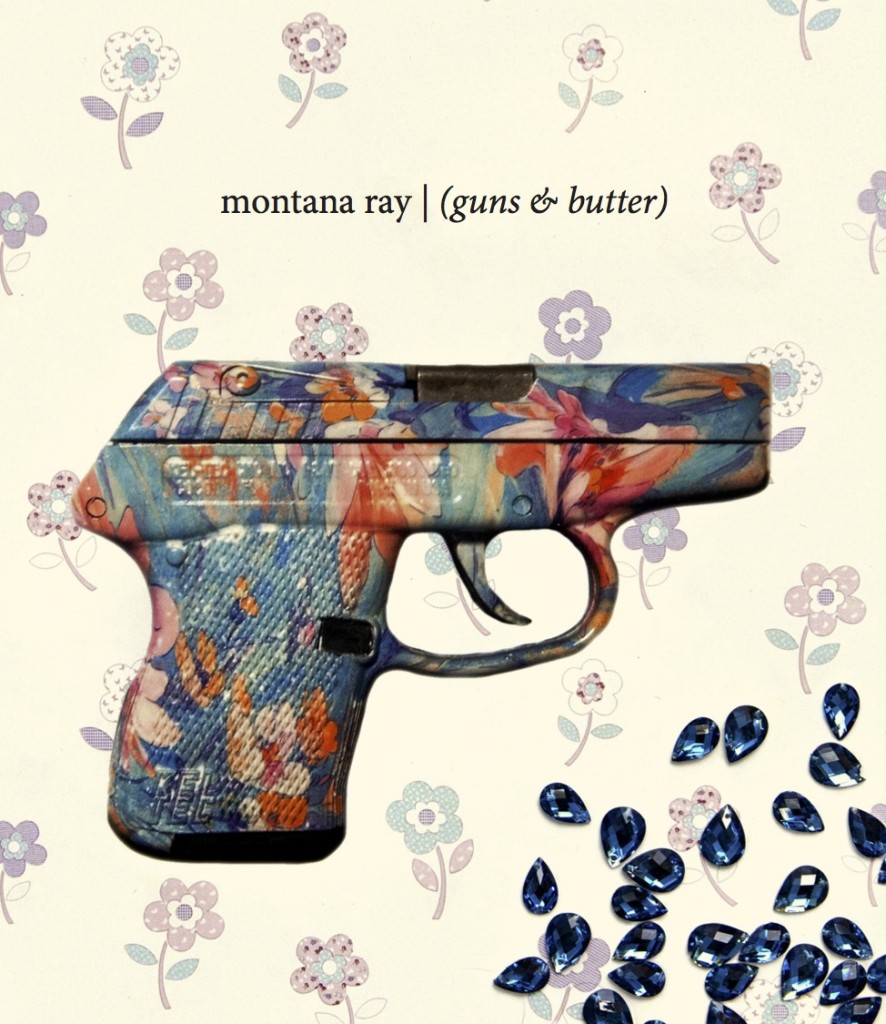
Joy Katz: These are concrete poems in the shape of guns. It’s tough to write about guns, let alone make concrete gun poems, without playing off predictable anger about our American gun obsession.

AG: What is more potentially cheesy and treacherous than a concrete poem in this day and age, right? And beyond the concrete shapes, there are so many layers of formal invention—the unusual use of texting conventions and emoji, and parentheticals—that could be gimmicky.

JK: Yes, especially Ray’s parentheticals. Amazingly, they are not fussy. The little encapsulated phrases are like bullets. The poems are actually loaded.

Yet Ray points the menacing-yet-erotic gun cliché straight at a reader’s face: “(u’re driving) (how kind) (would you like a blowjob)”. Is she getting off on this? It’s uncomfortable to read. Is it funny or serious? What’s the power relationship in the car? The poems succeed because there aren’t clear answers to those kind of questions. The speaker rides along, “(thinking of Stokely’s cool / kids campaigning) (in the pitch of night).” She’s pregnant, “(my body is an insane cornucopia)” — isn’t that a fantastic image? — and the poem lands on what may be the most critical complication of the book:

(how

to standup for the Brother)

(who holds my head down)

AG: I wanted to talk about the same exact passage. So much going on here—personally, politically, culturally, historically—at the intersection of oppressions. And the question asked goes unanswered, which is the only honest option, as far as I can see.

American Poetry Review vol 44 no 3

Posted by Elizabeth Clark Wessel, August 11, 2015.

Montana Ray interviewed at TCJWW

Sarah Clyne Sundberg: You frame yourself as a feminist. Do you think sexuality complicates feminism?

Montana Ray: I think I was trying to perform an examination of culture in this book, trying to think about how this relationship was conditioned by media and conditioned by my family heritage. But I wasn’t really systematic, or academic, in my approach. I was just kind of in it. I was interested in the slippage between feeling crazy, feeling like your sexuality is not your fault, feeling like you’re the only sane person for a three-state radius and then feeling like you’re totally insane. And I think that’s a really common experience for feminists.

Posted by Elizabeth Clark Wessel, August 11, 2015.

Montana Ray interviewed at The The

“I’m in the mountains right now at my sister’s place in Oaxaca, under like 15 wool blankets staring at these gorgeous mountains and being totally snobby and skeezed out by my sister’s living standards; you know sublime + expired Lala yogurt dumped into the garden and bed bugs meet tarantulas. And anyway last night my son, sister, and I were telling stories around her fireplace. And taking turns, and Ami was like I’m not really into telling stories, I more like to tell facts. So we pulled the story of Cupid and Psyche out of him, fact by fact. And I think that there’s a way that the poems in this book seek out language as fact. I’m interested in language as something concrete in the fact of its materiality.”

Montana Ray, interviewed by Fox Frazier-Foley

Posted by Elizabeth Clark Wessel, August 11, 2015.

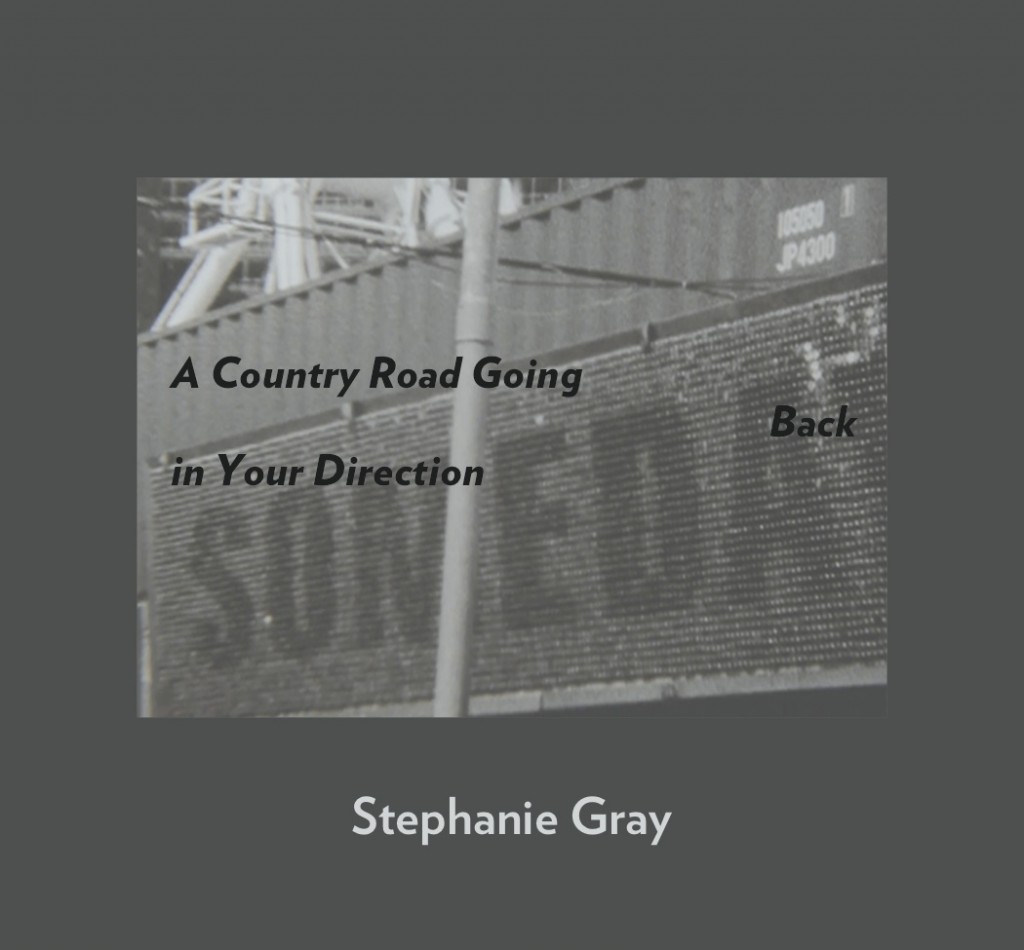
A Country Road Going Back in Your Direction

A Country Road Going Back in Your Direction

By Stephanie Gray

HAND-BOUND CHAPBOOK / $10


Just as cinematic language can bypass rational intellect and converse directly with memory, intuition and dream, Stephanie Gray’s poems casually subvert normative forms of communication and activate a kind of collective vernacular consciousness. “All the back roads changed…I had a job connecting dreams,” she writes, while her language does the mysterious work of linking philosophical rigor with delicious humor and deep investigations into the sonic. Hers is a poetry of vernaculars: of aphorisms, truisms and idiomatics, of the exhaustive pleasure to be found in lists, chants, catchphrases and “variations on a theme.” After reading Gray’s poems, it is impossible to hear cultural commonplaces in quite the same way—like Gray, you will want to make them your own. If Gertrude Stein appeared as a wisecracking secretary in a 1940s gangster flick, she might have Gray’s knack for thoughtful, disjunctive wit: “the secretary has seen it all.”

Poet-filmmaker Stephanie Gray is the author of two poetry collections, Shorthand and Electric Language Stars (Portable Press at Yo-Yo Labs, 2015), Heart Stoner Bingo (Straw Gate Books, 2007), and a chapbook I Thought You Said It Was Sound/How Does That Sound? (Portable Press at Yo-Yo Labs, 2012). Her poetry has been published in journals such as Aufgabe, Sentence, EOAGH, Esque, Boog City, 2nd Avenue Poetry, VLAK, Brooklyn Rail. She has received funding for her films from the New York Foundation for the Arts and New York State Council on the Arts. She has read her work often live with her films at venues including the Poetry Project Friday series, Segue series (with Tina Darragh), Triptych series (with Jonas Mekas) and others such as community garden Le Petit Versailles and Angel Orensanz Foundation. Her films have screened at fests such as Oberhausen, Viennale, Ann Arbor, Chicago Underground, and NYC venues such as Microscope Gallery, Millennium Film Workshop, and Mono No Aware. She had a retrospective of her films at Anthology Film Archives in Spring 2015.

Posted by Elizabeth Clark Wessel, June 17, 2015.

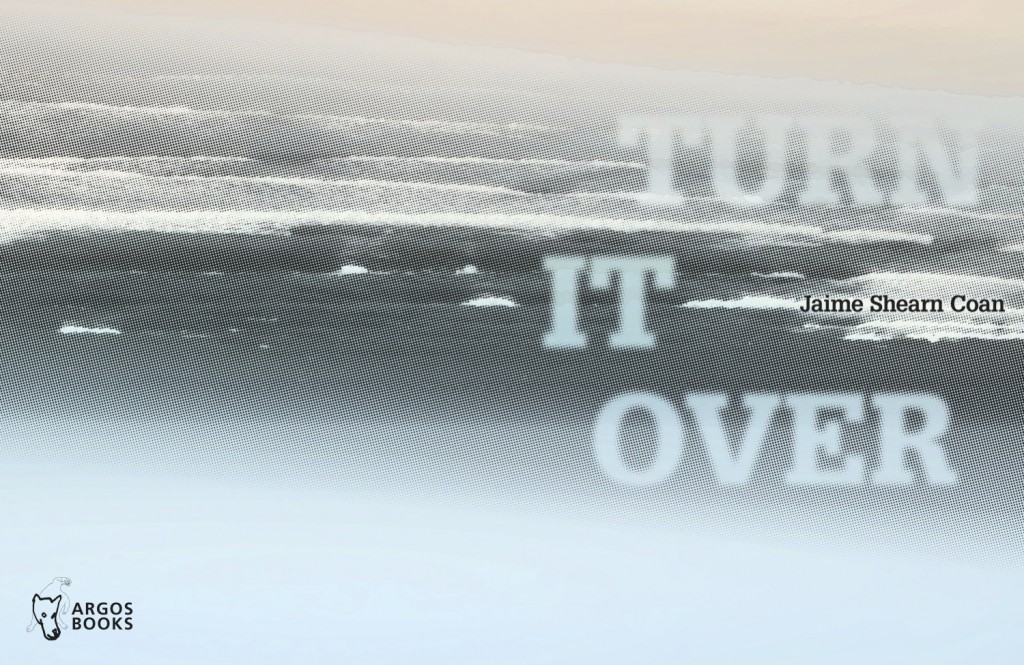
Turn It Over

Turn It Over

BY JAIME SHEARN COAN

HAND-BOUND CHAPBOOK / Sold-out

Turn It Over is a work of excavation; these poems seek to uncover where the self is located within the territories of memory, grief, family, secrets, and most especially the body. Shearn Coan writes, “How I formed a true question and am asking it still. What is more present than the body?” In precise and gorgeous language, he traces his own borders and maps his loves, while staying grounded in our material experiences. This is a work awake to the nuances of the body in embodiment, and it provokes this awareness in the reader as well.

Jaime Shearn Coan lives in Brooklyn, New York. His writing has appeared in publications including Drunken Boat, The Kenyon Review, Revista la Tempestad, and Troubling the Line: Trans and Genderqueer Poetry. He is a regular contributor to the dance section of The Brooklyn Rail. Jaime has received fellowships from Poets House, VCCA, and the Saltonstall Foundation, and is the recipient of a 2014 Jerome Foundation Travel and Study Grant. A PhD student in English at The CUNY Graduate Center, Jaime also teaches at Hunter College and The City College of New York.

space

Posted by Elizabeth Clark Wessel, April 18, 2015.

(guns & butter) reviewed at Entropy

From Art & Crisis (u can touch it): Montana Ray’s (guns & butter) by Brooke Ellsworth:

(guns + butter) invites us to read its shape as an idea firmly rooted in our contemporary experience of crisis: engage > delete. It invites us to read the voice in these poems by the same model. Our role as poem-spectator and civilian-spectator are inseparable. How do we measure the success of a poem in the shape of a gun? Or in the shape of a recipe? What is there to take away from any platform or prosody that is premised on the end-goal, objectivity, neutrality, the cathedral spaces of discourse? The two poles of this collection, guns + butter, are the consumables of these questions. Lethal + edible. They are evasive because of their everydayness. Ray reminds us that docility and absentmindedness are how we are asked to approach them, the newsfeed, drones, the tar sands. (The conveyors of political content) are not the conveyors of urgency that art can be.

Each poem in (guns & butter) comes into focus and quickly escapes it. The parentheses mushroom to an (((((((((((( inward rate, at the same time they and the recipes force us to engage some idealized result. (guns & butter) has us think about how our poetry becomes pressured by crisis, how we can pressure crisis and engender crisis with our poetry. A concrete poetry of a parenthetical narrative becomes an aesthetic imperative to recognize violence as its own organism, a beast we feed, a beast that feeds on us. Art is also a beast we feed, or choose not to feed. It’s when we overlook the conveyors of art within crisis, or the conveyors of crisis within art that we have truly given up. These are after all poems and we would die without them.

Posted by Elizabeth Clark Wessel, April 18, 2015.

Joshua Daniel Edwin & Sharmila Cohen at The Conversant

From The Conversant:

Sharmila Cohen: It’s pretty clear that translating a work like Kummerang would be no easy feat—can you discuss your process a bit? How did you tread the line between sound and content? Did you put more emphasis on one or the other? What were the particular difficulties you faced with it being such a sound-heavy poem? How much input did Dagmara have? Do you think anything was gained or lost in the process?   How was this experience different from other translations you’ve done?

Joshua Daniel Edwin: Translating gloomerang was certainly a challenge. The poem is ripe to bursting with sound-play and references and allusive connections and strange direct-address dialogue. Finding a balance between all these elements, or rather, figuring out a balance in English that worked as well as the balance Dagmara struck in German, was a long process. The first breakthrough I had was with the title. The original, “kummerang,” is a neologism that mushes together kummer (which means grief, troubles, sorrows, worries) with boomerang. My first solution was “boomeranguish,” which is pretty close in terms of sense-meaning, but all wrong in terms of sound. I kept thinking about it, and when I hit upon gloomerang, I knew I had found something good. It sounded right and it felt right. The sense-meaning wasn’t quite as close, but it was close enough and it captured the aura of the original. That set the tone for everything that followed.

Posted by Elizabeth Clark Wessel, April 2, 2015.

The Best of 2015 at Public Books

Morgan Parker at Public Books:

Montana Ray’s (guns & butter) and Liz Clark Wessel’s Two Suns

I haven’t dug a good concrete poem since, probably, reading Apollinaire. Montana’s, sometimes in the shape of a gun, sometimes in the shape of a vagina (a poem in itself), are as original and unforgiving as they are funny and relatably devastating. She takes on heavy topics like single motherhood, violence, race and family, examining and challenging tradition in content, cadence and form.

(guns & butter), arriving in April, will be the first full-length book from Argos Books, whose catalog of chapbooks and calendars is full of letterpressed, hand-bound knockouts. In addition to being a press committed to quality aesthetics, Argos is edited by dedicated writers with innovative and striking work themselves: co-founder Liz Clark Wessel’s debut Two Suns, also forthcoming this year from The Lit Pub, is gorgeous: thoughtful, earnest, and smart.

Posted by Elizabeth Clark Wessel, March 24, 2015.

Be A Dead Girl reviewed at Entropy

From Alexis Pope’s review of Be A Dead Girl at Entropy:

OK: I’ve made up my mind. I want Krystal to by my life planner. Hire her to speak through me when they put me in uncomfortable (& wrong) situations. I channel her on the phone call, stand up for myself. I channel a she the way she should be. It’s not a performance.

Languell delivers her bitch slaps with a laugh. Owns it. “Adults have relationships / nice work”

Languell’s intelligence & thought stand up straight in her fuck-off boots, but she’s not kicking. She’s shrugging because she doesn’t care if you get it. If you don’t get it, she’s not talking to you. “Holes are / abstract pleasures     if you didn’t know / they give direction     to feeling”

Direct me out the door. Direct me to the source of my life.

I’m writing this to say you should probably read this chapbook. Like, now. I’m writing this to say “A lot of shit will never happen” like me being able to talk like an intellectual about poetry. All I know is how to feel it. Languell speaks for me. I really don’t have to say much at all.

Posted by Elizabeth Clark Wessel, March 9, 2015.

15 Books I Can’t Wait to Read in 2015 at Weird Sister

Marisa Crawford at Weird Sister:

12) Guns & Butter by Montana Ray

The first poetry collection from self-described “feminist writer, translator, and mother” Montana Ray, Guns & Butter is made up entirely of poems written in the shape of guns that touch on themes including single motherhood, the literary canon, and gun violence. Cathy Park Hong says “[Ray’s] voice is mesmerizing, tender, vicious, chimeric, as she veers between role-playing a warrior glock-wielding Annie Oakley to “warm, new mother.” Read a few of Ray’s gun poems here, and get super-stoked.

Posted by Elizabeth Clark Wessel, January 20, 2015.

(guns & butter)

(guns & butter)

by montana ray

full-Length / $15


Combine Apollinaire with Pam Grier and you might come close to Montana Ray’s ferocious debut, (guns & butter). Each concrete poem is shaped like a gun and its poetic interiors are bracingly brutal and gorgeous. Capsuled in parentheticals, each magnetic phrase is locked and loaded as Ray burns holes into subjects ranging from interracial love, single motherhood, to America’s unrelenting addiction to gun violence.

Her voice is mesmerizing, tender, vicious, chimeric, as she veers between role-playing a warrior glock-wielding Annie Oakley to “warm, new mother.” I love (guns & butter) and cannot sing it enough praises. It’s the kind of rare first collection that is startling, necessary, and is truly like no other book.

–Cathy Park Hong

Read more about (guns & butter) »

Posted by Elizabeth Clark Wessel, January 15, 2015.

Real Talk with Amber Atiya at PW’s

Amber Atiya at Poets & Writers:

“These are moments I live for as a writer, scribbling notes in the margins of a SNAP booklet (“What You Should Know About Your Rights & Responsibilities”) or on the back of a voter registration form I’ll never use. Occasionally, these moments become poems, a couple of which appear in my chapbook, The Fierce Bums of Doo-Wop, recently published by Argos Books. (Shout out to my nephew J—-, who checked my ego by constantly asking, “Ams, what’s the name of your book again?” Only to walk off, chuckling, before I could answer.)”

Posted by Elizabeth Clark Wessel, December 1, 2014.

Iris Cushing On Publishing

Iris Cushing, interviewed by Jasmine Dream Wagner in the Conversant:

“Too often, I think, publishing is seen as a ‘goal’ of writing. It’s not. It’s one possible outcome, but there are hundreds of other equally good outcomes. My aspiration in editing Argos is to make the publishing process part of a continuum with the writing process. Poems are born in context, in the midst of a place and a time, among friends and lovers, plants and animals, grumpy co-workers and flirty bartenders; I want to take up publishing as a part of that whole. A book shouldn’t be something that is made when the poems are ‘finished.’ Rather, a book grows out of its context and leads to further changes, further growth.”

Posted by Elizabeth Clark Wessel, November 10, 2014.

2015 Argos Poetry Calendar

2015 Argos Poetry Calendar


HAND-BOUND CALENDAR

12 MONTHS

Sold-out

Time is both circular and linear. The last day of the year returns us to the first day of the next. The length of the days is repeated as the earth tilts back and forth, and our ecology responds. The rains return around the same time, the heat, the snow. And yet the days move forward, from one destination to the next. Calendars are our ancient way of making sense of this. Poems are our ancient way of making sense of something else. Poetry too is both circular and linear. Each word inevitably pushes forward into the next, and yet the last line of a poem returns us to the first. The poem creates its own time, and an ecology results when a mind encounters the poem. And so we hope this calendar offers the reader a unique way of experiencing the year by evoking poetry’s special relationship to time.

Our third annual hand-bound, limited-edition calendar features poems by Evie Shockley, Dana Levin, Jon Cotner & Andy Fitch, Khadijah Queen, Abraham Adams, Wayne Koestenbaum, Jennifer Tamayo, Johannes Göransson, Doug Nufer, Ana Gorría (trans. Yvette Siegert), E Tracy Grinnell, Marina Eckler, and more. With cover and artwork by ruby onyinyechi amanze.

Limited to an edition of 250.

[Painting by ruby onyinyechi amanze]

Posted by Elizabeth Clark Wessel, November 5, 2014.

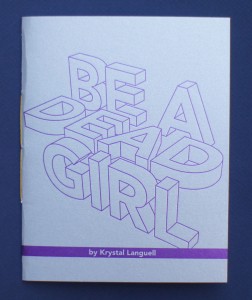
Be A Dead Girl

Be a Dead Girl

By Krystal Languell

LETTERPRESSED, HAND-BOUND CHAPBOOK / Sold-out

Krystal Languell’s deadpan wit in Be A Dead Girl subtly conveys the violence that happens with subjects are transformed into objects. In these poems, an “I” that is always in flux moves through a world that’s unsure where things end and people begin, and negotiates this uncertainty with quips that are seductively light on the tongue. The sly aphorisms embedded in Languell’s language are by turns visually stunning (“Beauty dissolves to make fire green”), hilarious (“Joyride to your grave”) and chillingly expressive of the perils of consumerism (“But I hemorrhage money privately”). There are refrains reminiscent of Pop songs, and a sensual phraseology that Emily Dickinson might use if she were tasked with writing advertisements for war machines. These poems invite the reader, at her own risk, to create continuity from a chaos that is all the more terrifying for its elusiveness: “If you came here for a story/put this in your mouth.”

Krystal Languell was born in South Bend, Indiana. She is the author of the books Call the Catastrophists (BlazeVox, 2011) and Gray Market (Coconut, 2015) and the chapbooks Last Song (dancing girl press, 2014), and Be a Dead Girl (Argos Books, 2014). In early 2014, Fashion Blast Quarter was published as a poetry pamphlet by Flying Object. A core member of the Belladonna* Collaborative, she also edits the journal Bone Bouquet. She is a 2014-2015 Lower Manhattan Cultural Council workspace resident.

—-

I am having what you might call a hard time: on Be A Dead Girl” a review by Alexis Pope at Entropy

Posted by Elizabeth Clark Wessel, October 31, 2014.

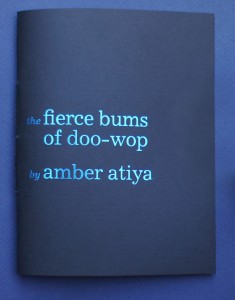
the fierce bums of doo-wop

The Fierce Bums of Doo-wop

By amber atiya

Foil-stamped, HAND-BOUND CHAPBOOK

Sold-out

Amber Atiya’s poems in the fierce bums of doo-wop arouse and terrify in equal measure. She has a rare ability to manage several complex valences at once— eros, comedy, and atrocity among them—skillfully braiding them into a whole, mysteriously synthetic body of work. Pleasurable and risky as “the urge// to fry bacon/ in my vegan/ lover’s favorite pan,” Atiya’s poems answer the urgent call of our times for language that is accurate yet imaginative, slick yet embarrassing, ethically gorgeous and hot as hell.


—-

Amber Atiya is a queer poet and native Brooklynite. Her work has appeared or is forthcoming in The Atlas ReviewBoston ReviewApogee JournalAnti-Muzzle Magazine, and elsewhere. She received a 2013 Pushcart Prize nomination, a fellowship from Poets House, and is a proud member of a women’s writing group celebrating 12 years and counting.

An interview with Amber Atiya at New Books in Poetry. 9/29/2014

Real Talk with Amber Atiya at Poets&Writers 12/1/2014

Amber Atiya reads from fierce bums at the Poetry Foundation.

Posted by Elizabeth Clark Wessel, September 20, 2014.

Results of our open reading period

Dear Friends of Argos,

During our open reading period last year we received over 200 chapbooks & we have been slowly reading, enjoying, pondering, and responding to these manuscripts ever since. The work we received made us excited to be publishers; there are such talented folks writing at this moment, and the fact that so many of them trusted us was a true honor. After much thought and discussion, we are proud to announce the following chapbooks will be joining the Argos catalog in 2014 & 2015:

the fierce bums of doo-wop by Amber Atiya
Symphony No. 2 by Emily Carlson
Turn it Over by Jaime Shearn Coan
Like a Country Road Going Back in Your Direction by Stephanie Gray
Poems by Ma Lan (translated by Charles A. Laughlin)
Go Ahead, Be a Dead Girl by Krystal Languell
& lunar flare by Levi M. Rubeck

Love,
Argos Books
(Elizabeth Clark Wessel, Iris Cushing, E.C. Belli, & Aiden Arata)

Posted by Elizabeth Clark Wessel, April 24, 2014.

Best Thing I’ve Read Today: 2014 Argos Poetry Calendar

From Vouched Books:

The past two years, Argos Books–which is run by E.C. Belli, Iris Cushing, and Elizabeth Clark Wessel out of Brooklyn, NY–has released a limited-edition, monthly poetry calendar.

This year’s version contains poems by Kazim Ali, Sommer Browning, Christophe Casamassima, Don Mee Choi, Ryan Eckes, Farrah Field, Joan Kane, Bhanu Kapil, Rachel Levitsky, Anna Moschovakis, Jared White, and Simone White. The illustrations were drawn by Essye Klempner.

While we’re already in the fourth month of the year, consider ordering one of these wonderful artifacts to hang on your wall so that you may pencil-in (and not forget) trips to the tropical fish store and next your Laser Tag outing.

Posted by Elizabeth Clark Wessel, April 3, 2014.